Thoughts on Savage Inequalities
I don’t know where to start. I picked up the book Savage Inequalities out of my library and decided to read it.
I’m pretty sure I had to buy it for my HST103 class and it was one of many books that never got read in my school years. (Its actually sort of ironic, I’ve become a semi-voracious reader, after I stopped going to college, go figure.)
The book is about the conditions of schools and the inequalities between schools in different areas. A recurring figure is the amount spent per pupil. This goaded me into figuring out how much money has been spent on my education. Its astonishing, from pre K Kindergarden to 12th grade there was over $100,000 spent on my education. Compare this to Mississippi where the same amount of money would’ve educated at least six students. Scary ain’t it?
I’m reminded of a comment one of my philosophy professors said about Islam. He stated that one of the failings of radical Islam is specifically ignoring half their population. (All females in some Islamic societies are essentially considered property and not allowed to contribute to society.) While we are not as guilty of ignoring such a large population of our society, we are guilty for not properly educating ALL of our children.
If you want to think of it in purely economic terms, children are a perishable good that must be invested in to have an economic return to society. There are two basic scenarios here. We take child A, who lives in a upper class New York City suburb where they spend $11,000 a year on A’s education. Because the community spends so much on A’s education they’re able to place A in a class of 18 students and provide A with a large list of extracurriculars to choose from. On the other end of the spectrum we take child B, who lives in a mediocre area of Brooklyn where they spend only $4,950 a year on B’s education. Because the community neglects B’s education B is in a class of 28 students that shares a room with another class of 27 students. The teacher is underpaid and specifically teaches toward the test. There are no extracurriculars to speak of whatsoever. (BTW: A’s and B’s parents were uncreative with names.)
This of course is a simple argument, B’s community does not care and therefore will let B’s education languish. This neglects the fact that the land owners in Brooklyn tax themselves (or are taxed by their tenants) at a higher percentage rate than the land owners in A’s suburb.
But I have assumed that it is logical and meaningful to define A’s and B’s communities by the location of their home. But the community that will be affected by the results of A’s and B’s education is much larger. While by the very nature of how lives are lived it is difficult to determine what the return to society A or B will make. The returns can be measured in multitudes of ways: children successfully raised, net value added to the GDP, taxes paid into the treasury, number of lives saved from a cancer treatment, amount of money spent incarcerating one or both after committing a crime, etc, etc. The point being that if one wished someone could provide scores that codified what a specific person contributed to society at large, and what they took from society at large. People usually take the most from society the younger they are and eventually start making returns. Children are society’s long term investment, the results of which will not be realized in the economy for upwards of 20 years. Plainly, individually children are a long term investment with a reasonable amount of risk, but a population taken as a whole the investment will pay off.
Given the ability to extrapolate A’s and B’s contribution to society as a whole it is ludicrous to tie their education to something as arbitrary as the location of their home. (This is not to say that this did not make historical sense when people were unlikely to leave the community in which they were born.)
As a result the method that is the most logical given the potential nationwide impact of A’s and B’s education is providing a majority of funding at the national level. In a way we already do this, just inequitably as Jonathan Kozol states in Savage Inequalities:
Because the property tax is counted as a tax deduction by the federal government, home-owners in a wealthy suburb get back a substantial portion of the money that they spend to fund their children’s schools –effectively, a federal subsidy for an unequal education. Home-owners in a poor districts get this subsidy as well, but , because their total tax is less, the subsidy is less. the mortgage interested that homeowners pay is also treated as a tax deduction — in effect, a second federal subsidy. these subsidies, as I have termed them, are considerably larger than most people understand. in 1984, for instance, property-tax deductions grated by the federal government were $9 billion. An additional $23 billion in mortgage-interest deductions were provided to home-owners: a total of some $32 billion. Federal grants to local schools, in contrast, totaled only $7 billion, and only part of this was earmarked for low-income districts. Federal policy, in this respect, increases the existing gulf between the richest and the poorest schools. (p. 55)
In addition funding education at a higher rate may in the long term reduce the need for federal and state expenditures, as a likely result of the lack of properly educating the whole population, is the need to incarcerate a significant portion of the population currently costs most governments approximately $20,000 per year, enough to educate two students at a reasonable quality level.
As a result we truly have dismissed one of our most fundamental responsibilities, ensuring freedom via a well educated populace. Thus by not educating and ensuring the productiveness of all children in this great nation, we are not only injuring those who are not educated well, but injuring ourselves.
CWRU Thoughts
Okay, I just got done with the campus tour part of my tour of CWRU.
I know these things always put the best foot forward, no matter what. Its like asking a dentist how a procedure is going to be, you’ll never get the answer: “You’ll be in excruciating pain for the next three weeks and you’ll always get food stuck.”
Okay all in all I’m impressed.
- This campus has character, there are old buildings, newer buildings, relaxing areas around the buildings, bike racks, etc.
- What seems like a real dedication to actual learning, its “both a liberal arts college and a major research institution.” (Yeah hows that for a marketing line?)
- There are actually residential communities, and most of the population is residential
- Taking classes outside of your major isn’t considered weird or abnormal, just something that people do.
- I talked with my tour guide, who is a lesbian, after the tour and she indicated that there is a pretty vibrant community, with little problems. In addition I know Cleveland supports enough of a gay community to have a pretty good sized bi-weekly newspaper. (as opposed to a gay-weekly newspaper.)
Can I just apply here and call it a day? I really want to get back into college, I just want to do it correctly no matter what, and I recognize that doing things correctly requires a proper amount of perspective and thoughtful planning, not jumping into it based on less than 24 hours of experience…
Geeze I don’t want to go back to Dayton, I really don’t. But at least I have a second job that I think I’ll actually like waiting for me when I get back. Yea!
BSFP
Ahhhhhhhhhh! there is a huge mass of fresh-people and their origin carbon based beings around me.
All these naive people who are attempting to discover what they want to do with their life but most likely have a reasonable chance of misstepping and wasting these years in school or getting a degree in something that they have no desire to work in.
At least I stopped before I got the degree, so no one can get confused and thing I’m credentialed in theatre; all they know is that I have a mass of credits floating in the ethereal space of college registrar’s computers.
This decision is slightly more tangible than it was a few weeks back, but I still don’t feel comfortable with it yet.
But I must stop now, time to get my BS filter going, the admissions presentation is about to start, so the BS is going to flow thick and hard.
Operating System Rant
One of those dangers that I have with writing eJournals offline is that I evaluate and reevaluate them and sometimes they just get stuck and delayed, like this one.
I really don’t want to get into the OS debate. I’m experienced in several operating systems and I’ve actually used many of them, so my opinions don’t come from a lack of experience. Even then this debate seems slightly frivolous given world events and the much more interesting debates of quantum physics.
I’d have to say that really the only things that prodded me into finally getting this done was Steven Johnson’s recent rant on Microsoft Word and an older look at Apple’s upcoming feature Expos
I tried writing with my left hand today. It was a result of trying to eat and program at the same time.
It looks like its written by a first grader, although I don’t know very many first graders with the logical skills to be able to program ANSI C, maybe Basic or Logo, but defiantly not ANSI C.
I’m in a huge muddle with SpamFolderManger. I’ve honestly never dealt with a project of this breadth and modularity. Honestly I’m really a Applesoft BASIC programmer who has just transplanted himself to ANSI C. This is the first time I’ve actually tried programming like a C programmer and I’m well lost.
I’ve got a bunch of functions lying around and well eventually they should be able to be properly stitched together to create a functional program.
I’m reminded of sessions with my mother when she’d have all the pieces for her quilt covering the floor and she’d be attempting to figure out what was wrong in her cutting so she could piece the whole mess of fabric together properly to come out with a quilt. She always used to be so methodical and graph the whole quilt out and figure out what she had to do.
I know I need to create a “map” of this program for myself, so I know which way is up and how I need to proceed. I feel like I’ve been given a hot skillet on a stove without a handle, and I’m having to figure out how to build a handle onto this. Its probably something like molecular chemistry. (Wait, thats redundant isn’t redundant?) I remember reading about buckeyminsterfullerene in Popular Science and how they had to graph a handle on it to take a picture.
Whatever the case I’m stuck feeling really stupid and really lost. Maybe I can learn to write with my left hand and program at the same time. My brain needs a good work out.
Of course I could be boring and take my second class on programming and just stick to my right hand for writing, but that just wouldn’t be interesting.
Veiled Profanity
I was just composing my last entry in Userspace, and I went to spell check it… Apparently the folks at Apple have a sense of humor. Give the image a click for the close up..
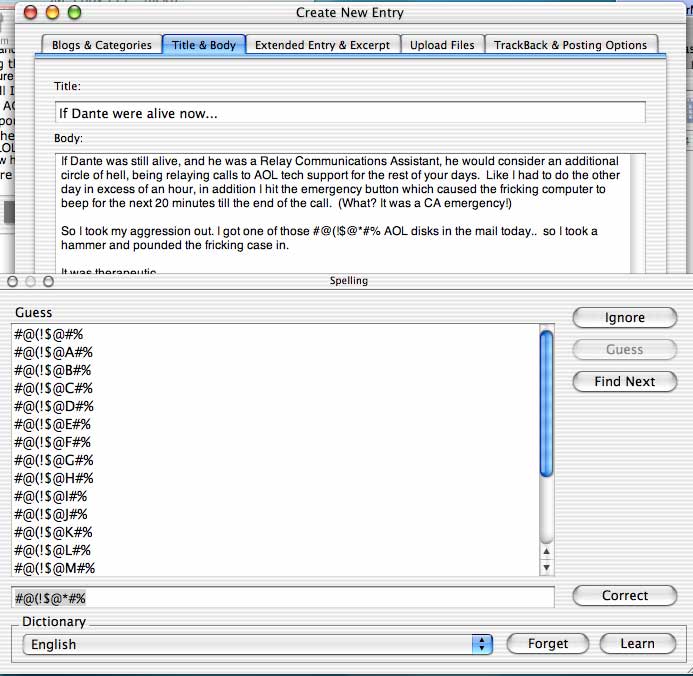
If Dante were alive now…
If Dante was still alive, and he was a Relay Communications Assistant, he would consider an additional circle of hell, being relaying calls to AOL tech support for the rest of your days. Like I had to do the other day in excess of an hour, in addition I hit the emergency button which caused the fricking computer to beep for the next 20 minutes till the end of the call. (What? It was a CA emergency!)
So I took my aggression out. I got one of those #@(!$@*#% AOL disks in the mail today.. so I took a hammer and pounded the fricking case in.
It was therapeutic.
Quantum Truth?
The Quantum Physics book as caused me to being to doubt scientific truth.
Here is the problem: Science is a pursuit performed by people making a hypothesis and then creating an experiment to test it. (or vice versa, starting with an experiment then coming up with an explanatory hypothesis.) The problem arises in that we can never prove a hypothesis true, only falsify a hypothesis. So since people are constructing the theory and the experiments the hypothesis and/or theory are rooted in the history of that science and the experience of people performing the experimenting and hypothesizing. A danger in this is the possibility that there is a false case floating around waiting to be recognized as such.
While of course a false case is a danger to the theory being falsified, it is also potentially detrimental to theories that have been structured as a result of knowledge gained or theory developed on the falsified theory.
This of course calls into question the whole nature of science. Is there some case that can destroy the fundamental nature of science? Perhaps one of the core precepts that all science is based on is false? What then?
The possible flaw in my reasoning of course is eventually after an unfalsified theory is used and explored so many times does it become truth? When does it cross this line?
Analyzed Bitching
I bitched out my friend A earlier today.
He’s got a position at work that gets more pay, but he has less work to do; well no work to do. (Its not his fault, just the Ohio Relay Contract is screwy.) This is his second job, his first being a pretty well paying job.
I’m not sure why exactly I exploded at him.
I’m quite sure part of it is that when he’s here its play time and lets entertain A time. While I don’t mind a good conversation it seems like a requirement and plus he ends up bothering other people who are working and he seems to have no courtesy for others who are working, calling busy supervisors for no reason at all, being loud behind other working employees, etc, etc…
Another possible reason for my bitchiness is that I see him having this job just so he can buy a house, which at the moment I see as an unnecessary luxury. He has a moderate sized four bedroom house for one person and two cats. This really just seems like showing off to me. Of course I’m not enthusiastic about home ownership. I see most houses as a waste of money.
First of all the mortgage payment is usually more than rent, but you get less. Rent includes repairs, property tax, often extra amenities, appliances, among other things. I know people often tout the equity in homes, but if you look at it you have to pay a lot of bank interest and other additional costs that you don’t have with an apartment, as a result your free cash flow should be higher allowing you to invest the extra funds.
I still don’t know why I went off on A. I guess its some of this stuff and just the plain fact that I’m tired.
Dang, do I look like an ass now?
Grass
It amazes me how much effort people put into grass.
My dad (at the moment) works for a lawn care company selling services to maintain this man made natural “carpet.” Of course we treat our lawns like bad children, it always needs lots of attention to make sure it is doing the “right” thing.
Suburbia is about the control of nature. (Assuming you can call the bastardized version of plants and animals that exists in suburbia nature.) Whereas urban areas for the most part just displace natural things and confine nature to specific areas, but urban areas make no attempt to look natural. There is no pseudo nature, controlled and contrived into a pretty picture to suite personal or communal tastes, as exists in suburbia.
It is my contention that grass was initially fundamentally like a Timex watch, or a SUV (or even a 17″ Apple Powerbook, despite its inherent beauty.) — It was something that was bought or maintained to show off the fact that you had money. Lawns (especially if you insist on very green lawns) are rather expensive to maintain with fertilizer, mowing, aerating, weeding, etc, etc…
The important thing to consider is whats the alternative? You could let wild grasses and flowers overtake your lawn and enjoy the true nature in stark contrast to the controlled primness of a “proper” suburban lawn. This is of course assuming that your neighbors and/or the city don’t take it upon themselves to mow your lawn and bill you for the trespassing and destruction of property. (Of course in their defense this is in the name of “property value.” Is it amazing how obsessed w are with money?)
Another alternative is to completely landscape your yard leaving no grass, albeit this only replaces on constructed nature scene with another.
You could finally put gravel in. (I’ve seen this in retirement areas in Florida.) Or, just pave the whole damn thing. (Although I can see the city complaining in this case as well.)
I’m also quite convinced that grass is a chosen weed, but I’ll have to research further to support this claim.